Cold Plunge for Superyachts - Installation Guide
On a superyacht, install a cold plunge in naval composite, fitted with an autonomous cooling unit, connected to the grey water circuit via a three-way valve, and controlled by automated water management software. Not a villa bath retrofitted after the fact - equipment designed from the outset for the marine environment: salt spray, free surface effect, limited fresh water, and uncompromising water clarity requirements.
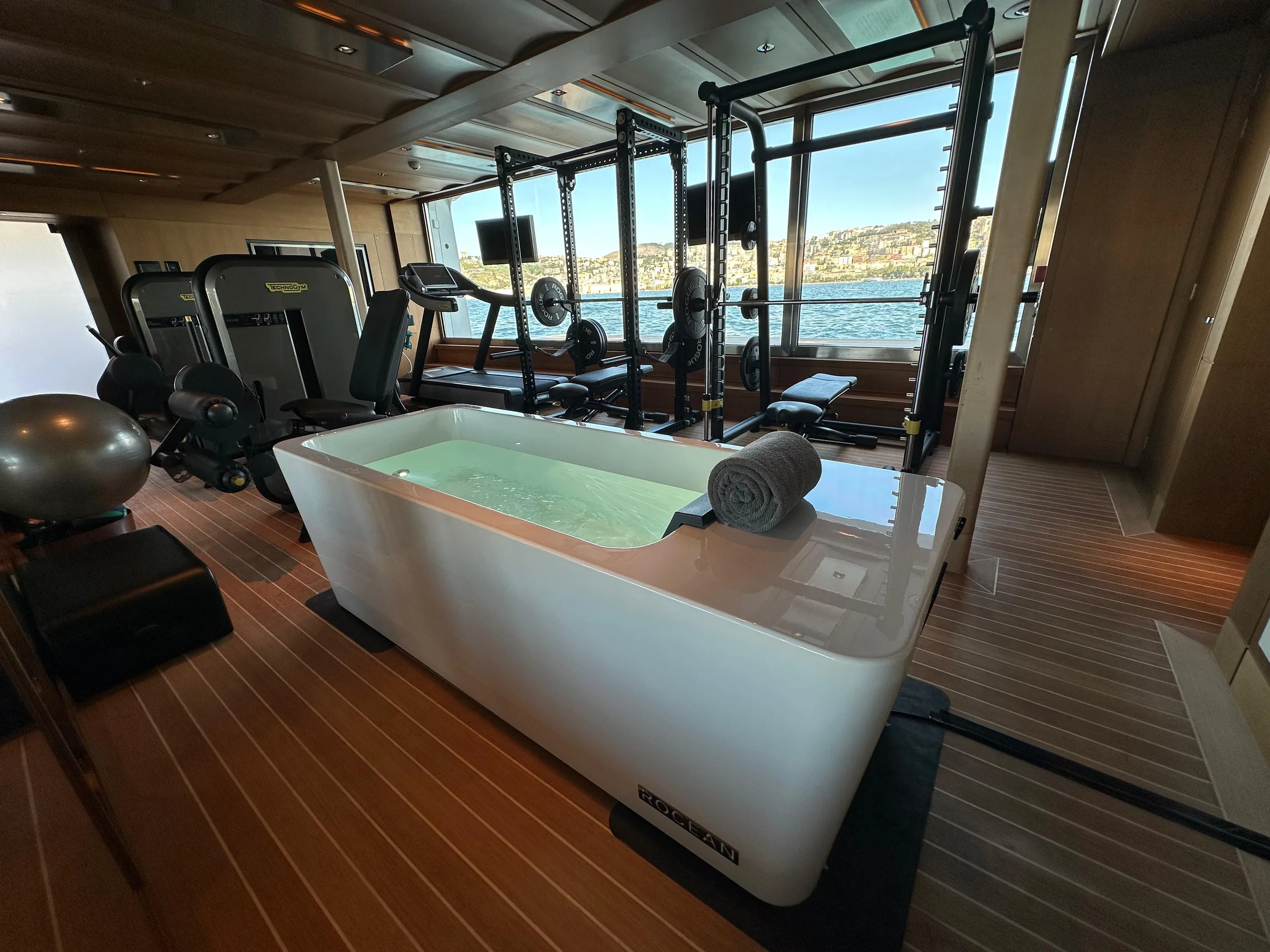
Why a villa cold plunge fails on board
Most cold plunges on the market are designed for a fixed floor: stable surface, unlimited water, gravity drainage, no maritime regulations. The moment you go on board, every one of those assumptions breaks down. A cold plunge on a yacht is a mass of water at height, on a moving platform, exposed to salt, subject to spray, with discharge rules that change by flag, navigation zone and port. This is not a budget issue. It is a naval engineering problem.
The material - naval composite, nothing else
Stainless steel corrodes. Not immediately, but salt, permanent humidity and hot/cold thermal cycles always end up attacking welds. Acrylic and standard resins are not rated for salt spray or prolonged UV exposure.
Naval composite - fibreglass or flax fibre with marine gelcoat - is the reference material in naval construction. Lightweight, rigid, perfectly watertight, UV and salt-spray resistant, it allows complex shapes and clean lines. Every Rocean unit installed on deck is built in composite. Not an aesthetic choice - a structural one.
Free surface effect - the constraint no one anticipates
A full bath underway creates a free water surface that moves with roll and pitch. This free surface effect degrades vessel stability. On a 50m+ motor yacht, the effect is manageable if the bath is positioned low and on centreline - but it exists, and must be assessed with the yacht's stability plans. The product implication: the bath must be able to be emptied and refilled quickly, without manual crew intervention. A single button, a confirmation - done. Without this, the bath simply will not be used underway.
- Navigating with the bath full - possible on some yachts where stability and structure allow. A case-by-case assessment with the naval architect.
- Draining before departure - the safest option in the majority of cases.
- Draining to a low, baffled holding tank - avoids immediate overboard discharge; the tank itself must be designed to minimise free surface effect.
Where the water goes - the real blind spot
This is where most amateur installations fail. The issue is not the volume of water - it is the chemistry it contains. Cold plunge water is treated, at low temperature, with an organic load after use. Discharging it directly overboard in a marina or enclosed bay quickly becomes an environmental and regulatory problem. Rules vary by flag, port and territorial waters.
- Dedicated drain outlet - separated from the seawater circuit.
- Three-way valve - grey water tank / overboard / service.
- Non-return valve - mandatory.
- Chlorine/bromine neutralisation - possible before discharge where the zone requires it.
- Software lock - prevents automatic drain in marina mode where a compliance logic is required.
Cooling - an autonomous unit, not the yacht's AC
Connecting the bath to the yacht's climate circuit seems logical. It is not. The AC circuit is not sized to absorb the thermal load of a cold bath, and in the event of a fault or overload, both systems go down together. Rocean works with an autonomous cooling unit, sized for the bath volume and usage frequency. More reliable, isolated from the rest of the vessel, and the only way to guarantee a fast return to temperature after a full water change - precisely where undersized systems fail.
Crystal-clear water - the point everyone underestimates
A yacht cold plunge is not judged at temperature - it is judged at the water. On board, two factors amplify the challenge: fresh water is not unlimited, and the water must remain crystal clear at all times. Draining and refilling daily is not viable.
- High filtration rate - the full volume passes through the filter several times per hour.
- Fine filtration - captures fine particles before they affect clarity and water chemistry.
- Automated partial daily renewal - a fraction of the volume replaced automatically each day to dilute organic load and extend the interval between full water changes.
Rocean OS - automation that makes the difference
All of the above - filtration, renewal, drainage, return to temperature - can be managed manually by a captain. But it represents constant work, and any undetected drift degrades the water. Rocean OS automates the entire protocol. Partial daily renewal triggers automatically. Filtration runs continuously. A full drain, refill and return to temperature happens in one tap from the bridge or from the app. Captains and chief stewards welcome the automation - it is less work for them. The system manages the water and alerts only when a parameter goes out of range.
Case study - Dana White's 95m

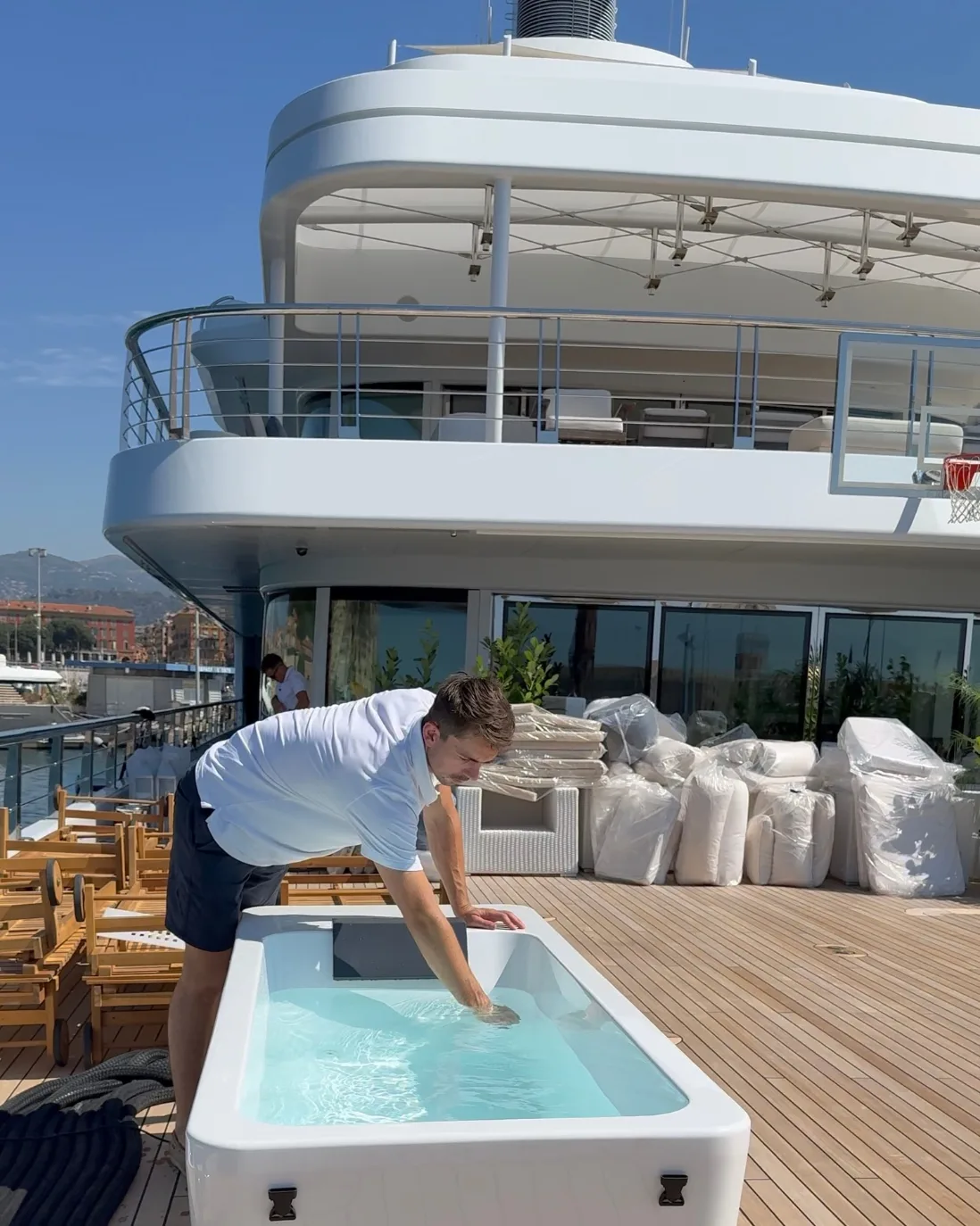
When delivering the cold plunge aboard Dana White's 95-metre superyacht, in transit from Croatia to Nice, one point became very clear: salt spray conditions underway are far more aggressive than most owners expect. A bath installed on the exterior deck receives spray continuously - not occasionally, but over passages of several days. Seals, connections, and technical access to the cooling unit must be designed for this from the outset, never retrofitted. This is precisely why Rocean builds in naval composite with marine gelcoat finish, and why every on-deck installation includes a position and weather exposure study.
The most common mistakes
- Choosing a product not rated for marine use - no account taken of applicable maritime safety regulations. A risk for users, owner and insurer.
- Poor water management - undersized filtration, no renewal, no protocol. Water becomes cloudy, unsafe, and eventually malodorous.
- Ignoring discharge chemistry - nobody thinks about neutralisation before evacuation until it becomes a problem in port.
- Connecting cooling to the yacht's AC circuit - apparently economical, but fragile. One fault and both systems go down.
- Cutting costs at installation - everything saved on filtration, treatment or automation translates into heavy maintenance, frequent water changes, cloudy water and odours. The most expensive mistake.
Budget
For a complete Rocean installation on a 50m+ yacht - bespoke product in naval composite, autonomous cooling unit, hydraulic architecture connected to the grey water circuit, Rocean OS, on-board commissioning and crew training - budget approximately €92,000. In context, a spa refit on a vessel of this size runs to hundreds of thousands of euros. The cold plunge represents a fraction of the budget, but its impact on daily use and perceived value is disproportionate. Specified at design stage or at the start of a refit, it integrates cleanly; added at the last minute, it costs more and integrates poorly.
Frequently asked questions
How much does a superyacht cold plunge cost?
A complete Rocean installation on a 50m+ yacht - naval composite hull, autonomous cooling unit, Rocean OS, hydraulic architecture and on-board commissioning - is approximately €92,000.
Why not connect the cold plunge to the yacht's AC circuit?
The AC circuit is not sized to absorb the thermal load of a cold bath. An autonomous unit is more reliable and keeps both systems independent - a fault on one does not take down the other.
What is free surface effect?
It is the degradation of vessel stability caused by the free water surface in a full bath underway. It must be assessed against the yacht's stability plans before installation.
How is water treated in a Rocean yacht cold plunge?
High-rate dual-stage filtration, automated partial daily renewal, and a three-way valve architecture (grey water tank / overboard / service) for compliant discharge.
What material is used for a yacht cold plunge?
Naval composite - fibreglass or flax fibre with marine gelcoat. UV-resistant, salt-spray resistant and rated for thermal cycling. The reference material in naval construction.
Can the bath be emptied and refilled remotely?
Yes. Rocean OS allows full drainage, refill and return to temperature in one tap from the bridge or from the app, without crew intervention.